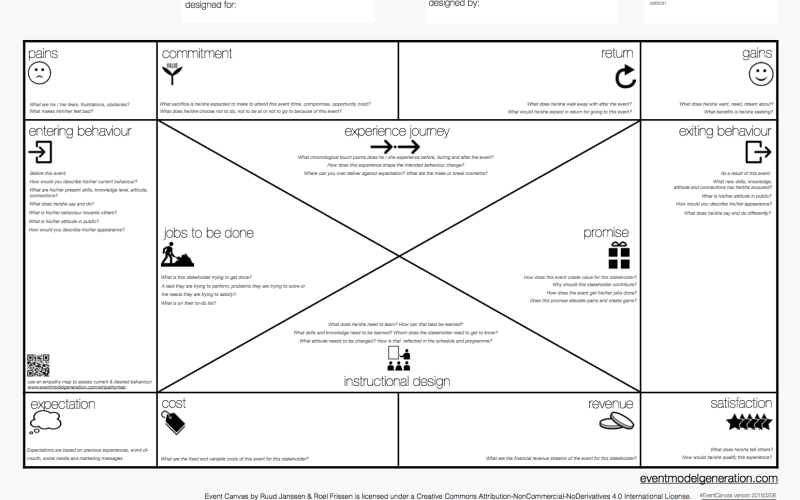
Organizing an event always has a specific purpose. Based on this, you create an Event Strategy for your event. The Event Model Canvas is a framework you can use when designing this strategy. With the Event Model Canvas, you innovate or sharpen your event strategy.
Before the canvas can be filled in, some explanation is required. It is, after all, a strategic management template where events are thoroughly analyzed from the ground up; ideally, the outcomes are directly implementable.
Step 1: Determine Stakeholders
Before we can use the template, we need to know who it is being filled in for. Once the target audience is determined, you can proceed. The entire canvas is written from the perspective of this stakeholder. If there are multiple stakeholders, you will need to fill in the canvas multiple times. Some parts will naturally correspond with each other.
Step 2: Entering behaviour
Your target audience has a certain way of thinking and acting. We are going to analyze this during this step. It is important that you know, for example, the average level of education, level of knowledge, but also professional attitude and connections. How does the target audience deal with this in daily life? What is this person trying to project? Answering these questions leads to a better understanding of who will actually be attending your event.
Step 3: Pains
Your target audience faces challenges in life, just like everyone else. What is a concrete obstacle for this target group? What makes this person feel frustrated? Do they have fears, frustrations, and the like that show a recognizable pattern? If you have little knowledge of this, you can gather input by asking to interview a few individuals within the target group to pinpoint their pains.
Step 4: Expectations
The target audience may have attended similar events before. Have they developed certain expectations as a result? Or are there influential factors that cause the target audience to have a minimal expectation regarding your event? What feeling or knowledge does the visitor want to take home after the event? Map this out as accurately as possible here.
Step 5: Exiting behaviour
The target audience has attended your event; how do they leave? What has changed? Have they developed new skills, has their attitude changed, or have they made new connections? Above all, the question is: will the target audience behave differently after visiting your event?
Step 6: Gains
What is the target audience specifically looking for? Everyone has dreams and interests; how will your event address these? The better this is mapped out, the better you can meet the desires of your target audience.
Step 7: Satisfaction
Once the event has taken place, you can assume that the visitor returns home with an opinion. The aim, of course, is for this opinion to always be positive. In this part of the canvas, you ask the genuine question: what is this visitor going to tell others? What was the quality of the experience?
Step 8: Commitment
When a visitor comes to the event, they have to free up time to attend. Alternative activities are always given up to clear this time. What could these activities be at the chosen date/time of your event? Is it worth it for the target audience?
Step 9: Return
As established earlier, the visitor has certain expectations. How are you going to meet them with your event? What does the visitor ultimately walk away with? This is less about the feeling as filled in under Satisfaction, and more about concrete takeaways.
Step 10: Cost
People incur costs to visit the event. What are the guaranteed fixed costs and optional variable costs for the stakeholder? Map this out as accurately as possible in this section. Think about ticket costs, travel expenses, food costs on-site, etc.
Step 11: Revenue
Where there are costs, there is hopefully also revenue. The visitor has made some expenses; what can they expect in return over time? Examples include a higher salary due to new skills, a new job, or new clients.
Step 12: Jobs to be done
People are getting busier. In our current society, people quickly answer the question 'how are you?' with 'Yes, very busy'. This most likely applies to your stakeholders as well. What is on their to-do list?
Step 13: Promise
What is the added value of the event for the stakeholder? Can they assume there is a good reason to attend? The purpose of this added value is to focus on reducing pains and strengthening gains.
Step 14: Experience journey
We are nearing the end of the event canvas. This brings us to an important part where you, as an event manager, actually gain insight into the stakeholder. What are the touchpoints with the stakeholder before, during, and after the event? Where in these touchpoints will the event change the behavior of the stakeholder?
Step 15: Instructional design
Now the practical components for the visitor are addressed; what are they going to learn? How are they going to acquire the desired knowledge? Which skills, connections, and behavioral changes are achieved at what point during the event? You do not need to create a complete timeline here; that is part of the actual event planning. You need to connect parts of the event to the key takeaways for the stakeholder.
Use the Event Model Canvas as the foundation for your Event Strategy
All things considered, it is a relatively simple way to establish a successful event strategy. Perhaps incorporating sustainability is an added value for your company? Then read our blog here about how to integrate sustainability into an event strategy.
Curious about how Theater Amsterdam can help implement the desired outcomes of your event strategy? Feel free to request a tour via events@theateramsterdam.nl.

Eva Otto
Director
About Theater Amsterdam
Theater Amsterdam is a unique venue on the waterfront. With a Theater Hall for 1,100 guests and a Blackbox of 1,200 m², it offers everything for events up to 2,000 guests. The projection screen and technology ensure impact at congresses and shows.
Every event a show
Planning your event at Theater Amsterdam?
Based on your programme, we can immediately help you create a logical event flow.