
Safety is a vital component when organizing events. As an organizer, you are responsible for the safety of the public, staff, participants, and public property. The larger the event, the more important it is to be well-prepared for all risks. Incidents, emergencies, and nowadays, event organizers must also think about preventive health measures. Ensure you don't forget anything when organizing your safe event with this handy checklist.
The safety plan
With a safety plan, you make risks and measures transparent. It is useful because you have thought of everything beforehand. And for events in risk class B (medium safety risk) and C (high safety risk), it is also mandatory. Furthermore, you also need it when you have to apply for a permit. The municipality and emergency services determine on the basis of this plan whether additional measures are required for a safe course of the event.
The safety plan contains all potential dangers and risks. With a risk matrix, you estimate the impact of the most important risks. In this way, it is easier to prioritize safety measures. In order of priority, you then develop solutions to eliminate and reduce risks. A traffic plan, evacuation plan, fire safety plan, security plan, and medical and health plan are all components of a good safety plan.
When the safety plan is ready, you inform everyone involved in the organization of the event by providing them with this plan. Properly informing all parties involved reduces the risks during execution.
The venue
Before choosing a venue, check whether it meets, or can be adapted to, all safety requirements. Go through at least these four components:
Capacity: can visitors be safely accommodated at the chosen location? Will they be sitting or standing? Is there room for movement and a 1.5-meter distance?
Access: can everyone enter and leave the location safely? Are there different entrances and exits to create a one-way flow? Are there sufficient emergency exits? Is the location also accessible for people with disabilities and wheelchairs?
Hazards: are there dangerous elements in the space or surrounding area? Think of power cords, unevenness in the floor or landscape, or water in the immediate vicinity? At indoor locations, good lighting is important in places where people move. Stairs, steps, and exits must be clearly visible. Staff must also be able to work in sufficiently lit areas when, for example, setting up and dismantling the event. More hazard here means higher risk. For events at outdoor locations, take different weather conditions into account and consider what a flood or a gust of wind can do to tents, stages, and stands.
Accessibility and facilities: how far are the nearest emergency services and the hospital from the location? Can emergency services access the location easily if something happens? For high-risk events, the permit is only issued after an inspection by the emergency services, who come to inspect and check on-site.
Covid protocol
The prevention measures regarding Covid can no longer be ignored when organizing an event. Based on the Covid protocol, you translate the current rules into measures that suit the event and the location. You also inform all involved parties such as clients, organizers, participants, suppliers, and visitors about the guidelines by means of the protocol.
Matters that should at least be included in the protocol are:
Triage prior to or upon entry: asking about symptoms, measuring fever, testing, or checking vaccination passports.
Visitor registration.
Ensuring the 1.5-meter distance, such as walking routes and seating, floor markings, set-up and dismantling, and limiting the number of visitors.
Hygiene measures such as disinfection options, guidelines for hand washing, cleaning, and the safe preparation of food and drinks.
Wearing face masks indoors.
Triage (checking for Covid-19)
A check for (symptoms of) Covid-19 can be done in various ways.
Questioning visitors personally.
QR code on the CoronaCheck app – which gives 40-hour access after a negative test.
Contactless thermometers.
Recent negative PCR test.
Vaccination passport.
We do not yet know which of these options will make large and small events possible again in the near future. We update this page as soon as there are new rules and developments.
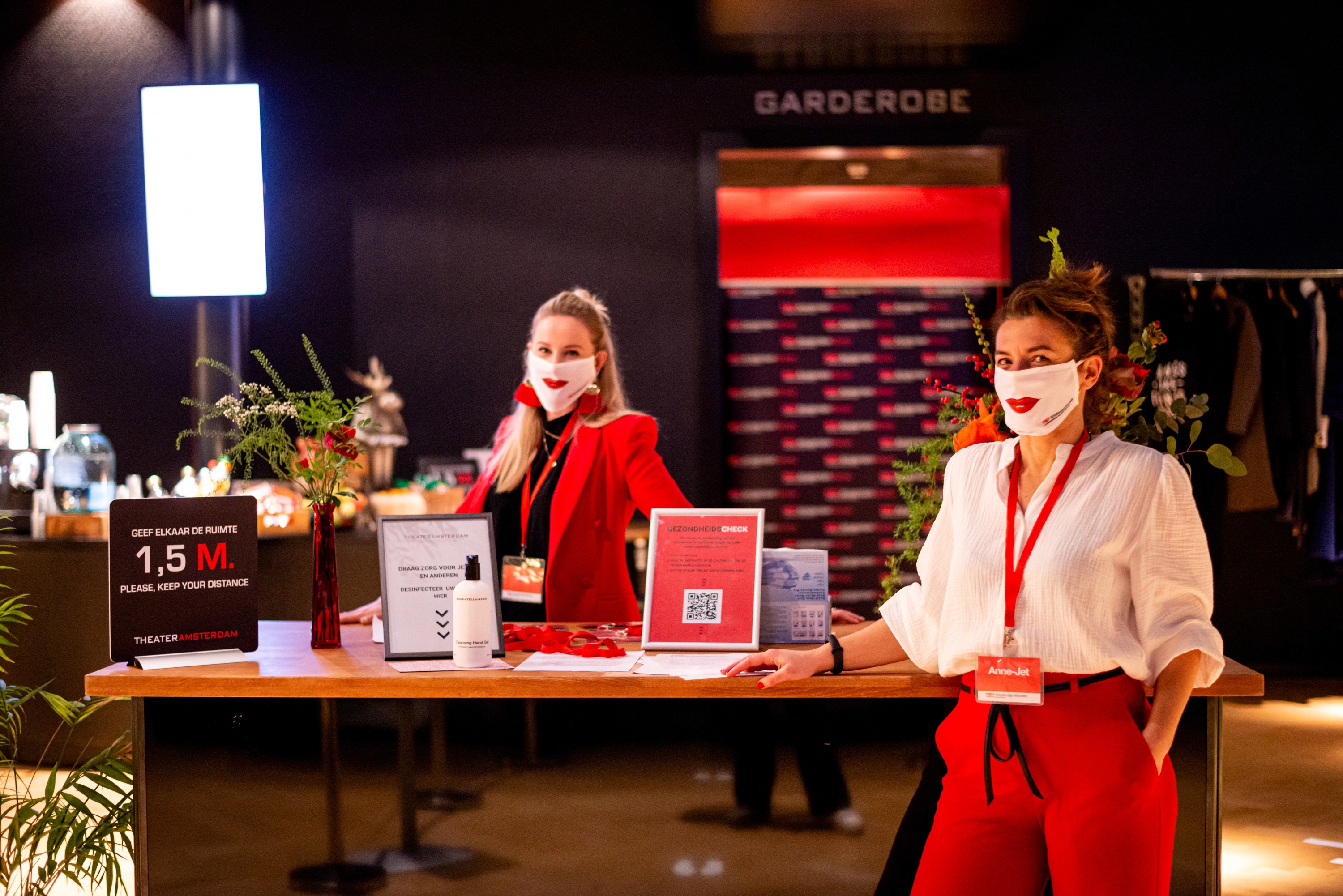
TedX AmsterdamWoman @Theater Amsterdam
Communication & signage
You want to prevent ambiguities during an event - or worse, during an incident or emergency at an event - at all times. You do this with good communication beforehand and during the event. Prior to the event, you inform all visitors and employees about the safety measures by means of clear emails and, for example, attachments to the tickets. Nowadays, applications can also be used to inform visitors beforehand about the rules, facilities, program, etc. Apps such as CLOSE and Momice can be fully customized for this and ensure that the visitor is always kept informed of the latest details.
When the event starts, good signage is of vital importance. By this, we mean signs, posters, and screens on which you communicate the rules, emergency exits, first aid posts, walking direction, and other instructions using text and icons. Walk through the entire location. From entry with the cloakroom to the hall, the toilets, catering, and leaving again. Is everything clearly indicated everywhere?
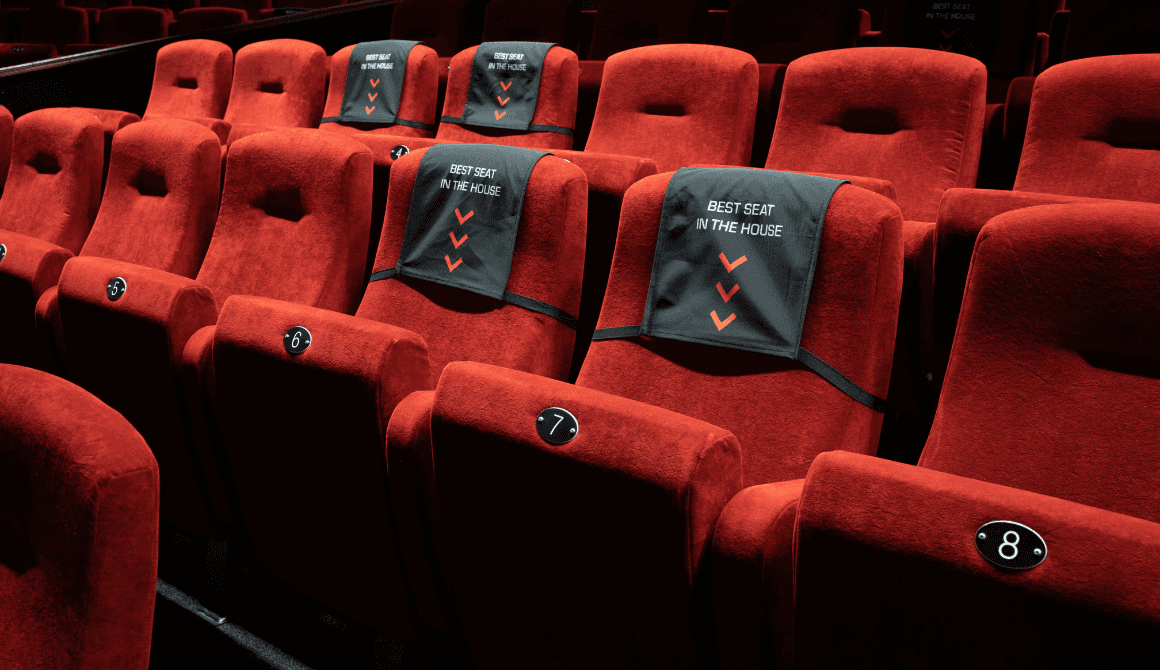
Signage on the theater seats @Theater Amsterdam
Safety staff during the event
Should something happen, acting quickly is essential. Human effort plays a major role in this.
To implement the safety plan properly, a well-organized emergency response (BHV) organization with sufficient staff who have received emergency response training is of essential importance. Based on the number of visitors, you determine the number of emergency response officers to occupy each position. Acting quickly in case of incidents requires alert eyes at strategic points of the venue. The emergency response officers know the safety plan by heart, know what to do in case of evacuation, and can provide first aid if a visitor becomes unwell. These employees also supervise and can give instructions to the public. You can also deploy security staff for this, depending on the nature and risk level of the event. You lay down this approach in an emergency response plan.
Help with your safety plan
Organizing an event at Theater Amsterdam? Our team has done this many times before. We are therefore happy to answer all your questions about the safety of your event and can help draw up a safety plan.
Already making plans for an event? At Theater Amsterdam, you can flexibly scale your hybrid event up and down, matching the measures in force at that time. Feel free to contact us.

Eva Otto
Director
About Theater Amsterdam
Theater Amsterdam is a unique venue on the waterfront. With a Theater Hall for 1,100 guests and a Blackbox of 1,200 m², it offers everything for events up to 2,000 guests. The projection screen and technology ensure impact at congresses and shows.
Every event a show
Planning your event at Theater Amsterdam?
Based on your programme, we can immediately help you create a logical event flow.