
Sharing knowledge is not as important in any other industry as it is in the medical field. Therefore, despite COVID-19 measures, medical congresses must simply continue. And virtually is the (temporary) new normal. Doctors, medical students, and scientists form a specific target group with specific needs. As the organizer of a medical congress, you have to take that into account. What are those needs? We have done some thinking for you.
Tip 1: Go for quality
Busy people, who are generally occupied with health, life, and death, do not have time for poor visuals and a lagging connection. So do it right, or lose your audience.
Create a real experience and ensure top-quality equipment. We are talking about multiple cameras, a sound system, a large screen, and projectors.
No matter how fancy the equipment is, if the groundbreaking information doesn't reach the audience at home, it's all for nothing. Therefore, ensure internet with adequate bandwidth.
Organizing a virtual event is new to most, and it involves a lot of technology. Hire skilled people to operate the equipment and coordinate the programs. Tip: our XL Studio is perfect for a livestream and you can rent it complete with all the technical gadgets mentioned above. In addition, we deliver a ZOOM Wall, a handheld camera, and a crew to operate it all for you.
Tip 2: The right timing determines the number of 'visitors'
The medical target group generally has a full schedule. When the congress takes place, and how long it lasts, are two determining factors for the number of visitors. This is how you make the most of it:
Choose a time when there is plenty of room for your event. Therefore, check if there are no other medical conferences on your date. And pay attention if students belong to the target group, that the event is not held during or just before an exam period.
Announce the date far in advance. This way, others will also take you into account, and the organizers of other medical conferences will plan around your event.
The weekend is probably preferred by practicing physicians. You cannot just make patients wait for a conference during the week. For students, the afternoon might be a fine time. To make sure you choose the right moment, a survey asking about preferences is a good idea.
Tip 3: Medical professionals are not passive types
Medical professionals attend medical congresses because they want to learn, and they often have something to say themselves. They work on matters they like to speak about with others. An opportunity to participate and network is therefore essential.
Online networking is new to most participants. Therefore, make an online manual with tips & tricks available beforehand. This way, the participants will start talking to each other directly during the event.
Guide participants in creating a profile with a photo and some (minimal) relevant information such as role, organization, and (medical) interests.
Enable asking questions during and after speakers' sessions with the chat function. Let the speaker answer questions and respond to comments from the participants.
A chat manager can filter remarkable questions and signal and resolve any connection issues.
Encouraging or triggering participants to join in works well with a poll or quiz element.
Tip 4: Make it visually interesting
Despite the fact that there is mostly a lot of listening to be done, it is also important to keep the eyes occupied in a pleasant way. Because listening makes up a large part of it, it is important that you also keep the eyes busy in an engaging manner. In this way, you maintain attention and keep engagement high.
As a speaker, it is much harder via the screen. You are competing with all the distractions of notifications that simultaneously demand your audience's attention. People walk away from a laptop more easily than from a hall. How to prevent this:
Go for a visually attractive space. A real stage and a sizable hall give a professional look. It says: this is an important moment.
An important requirement of the space is large screens on which the speakers visually support their story with images.
A virtual tribune on a large screen is nice for the speaker and the participants. A sense of community is created.
Tip 5: Digital exhibition floor
Medical congresses are also characterized by the fact that there is often an opportunity for sponsors to draw attention to their new products. This exhibition floor is also often used as a networking square where participants can talk to both the sponsors and other participants in a relaxed atmosphere.
Design a digital exhibition floor and offer sponsors the chance to set up their own digital booth.
In this way, a sponsor can show their new products as well as engage in digital conversation.
Schedule time in the program to allow participants to network with the sponsors in these virtual booths.
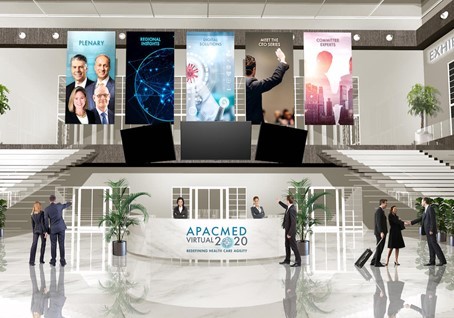
Source: APACMed Virtual Forum 2020
Tip 6: Content, content, content
Before events were held virtually, medical professionals flew in from all over the world for medical congresses to gather specialized information and meet peers. An online medical congress can therefore achieve environmental benefits. Nowadays, the necessity and environmental impact of attending a congress will be considered first.
Ask yourself when organizing your virtual congress, whether your target group would get on a plane for this.
Let content dominate the agenda with the best international speakers and scientists in the field. If you have the speakers, you have the visitors. And the higher the quality of the speakers, the more interesting the audience becomes to each other, as connecting with peers is an important reason to visit a (virtual) medical congress.
Find the balance between in-depth topics and more general sessions for a varied program.
Consider visitors in different career stages and provide sessions and activities for the different sub-target groups within the target group that may run simultaneously.
Create a digital platform with videos, blogs, podcasts, and other content about the topics to be covered prior to the conference. Invite participants to submit papers and research results. Start discussions on forums. This involves visitors with the event beforehand. This helps to get your target group enthusiastic or curious and thus ensures more visitors.

Source: De Groene OK
Theater Amsterdam has converted the Theatre Hall into an XL studio for livestream events. Curious about what your virtual event at Theater Amsterdam could look like? Download here our brochure for the possibilities.

Eva Otto
Director
About Theater Amsterdam
Theater Amsterdam is a unique venue on the waterfront. With a Theater Hall for 1,100 guests and a Blackbox of 1,200 m², it offers everything for events up to 2,000 guests. The projection screen and technology ensure impact at congresses and shows.
Every event a show
Planning your event at Theater Amsterdam?
Based on your programme, we can immediately help you create a logical event flow.