
Artificial Intelligence is often discussed as a promise for the future, but Part of the Narrative makes it practical for today. With their workshops, they help event professionals apply AI smartly in concept development, content creation, and preparation. To keep workshop participants up to date on the latest tricks and tools a few times a year, they developed DemoClub: an inspiring format in which AI is tested live with real input and realistic scenarios. The very first edition took place in Theater Amsterdam, where Xander Kranenburg and Wytze de Haan demonstrated what is already possible with AI within the event industry today. Concrete, applicable, and directly relevant for anyone working on concept, content, and execution.
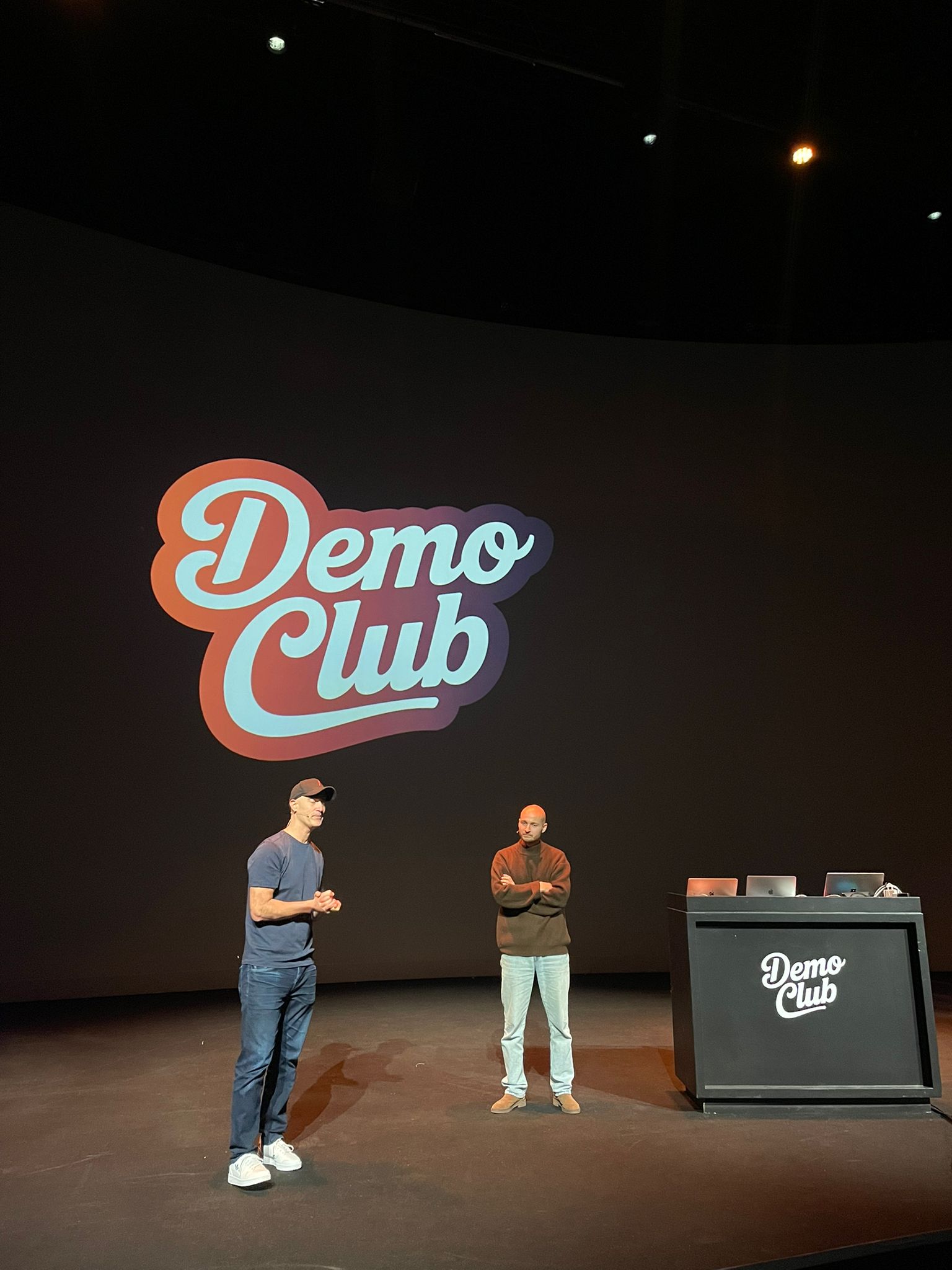
During DemoClub, event professionals gathered who wanted to discover how AI can already help today in the preparation and execution of events. In Theater Amsterdam, tools were not only shown but also directly tried out in an environment where spatial and technical choices are immediately tangible. The approach of the afternoon was clear: showing which tools exist, how they are used, and what that means in practice. By deliberately choosing live demonstrations, it became visible how AI behaves with real input, and where it adds extra value in a realistic setting.
From idea to briefing: starting faster with speech-to-text
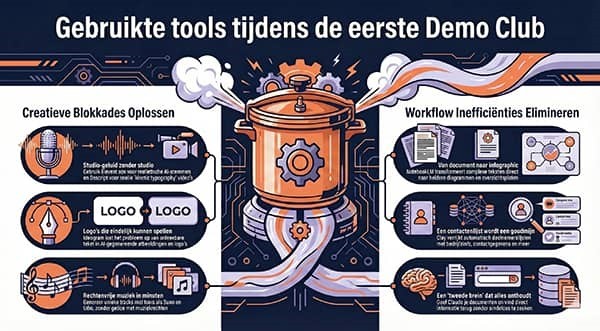
One of the first applications demonstrated was speech-to-text. Instead of typing out ideas afterwards following a meeting or site visit, an event concept was literally spoken aloud and directly converted into text. Tools like Wispr Flow show how spoken input can be used as the basis for an initial briefing or program structure. Capturing key messages for speakers or writing a rough draft for announcements and invitations can also originate directly from a conversation. For events, this primarily means saving time upfront. Ideas do not linger in loose notes or heads but are quickly captured in cohesive texts. Especially in phases where multiple stakeholders are involved, this helps to reach a shared starting point faster.
From technical input to overview in preparation
The processing of large amounts of information was also covered. In doing so, it was demonstrated how different documents and sources can be analyzed together, making connections visible faster and follow-up questions more targeted. DemoClub showed how AI tools such as NotebookLM can be deployed to reduce extensive documents to their essence.
Think of technical plans, scripts, program schedules, or input from multiple stakeholders coming together in a single document. Briefings for suppliers or speakers can also be made clear more quickly, while documentation that normally takes a lot of time to go through can be directly reduced to the core. In NotebookLM, visual summaries and infographics can also be generated to make complex schedules clear. Additionally, a dynamic podcast can easily be made from a briefing, allowing employees to listen to information beforehand instead of reading it.
This creates insight faster into what is relevant for the next step in the process. This helps prepare choices on how an event should shape up spatially and technically, even before production gets underway.
AI visuals as a guiding tool
On a visual level, AI was deployed to make concepts immediately visible and to guide clients in a new direction at an early stage. With image generation tools such as Midjourney, mood boards were generated in a short time to explore and discuss visual styles.
During the demos, extensive attention was also paid to the translation into practice: how do you ensure that content is not only beautiful on a laptop but also works on large screens and projections? In Theater Amsterdam, where screen sizes and aspect ratios differ greatly from standard 16:9, it became clear how important it is to take this into account already in the concept phase. By deliberately working in Midjourney with custom aspect ratios, higher resolutions, and upscaling, content can be made suitable for any desired format relatively easily. Thus, without the intervention of a designer, content was customized in no time for the 500m2 projection screen of Theater Amsterdam with 7000 pixels.
Additionally, it was shown how supplementary tools, such as Vectorizer for logos and Topaz Video AI for moving images, can help make AI-generated content suitable for print, projection, and video. The demos made it clear that AI visuals primarily add value when they are tested early against scale and technical context, so that visual choices are not only creatively correct but also hold up in the space. Precisely because AI quickly yields convincing images, it was emphasized how important it is to keep testing these images against the physical reality of a venue.
Practical voice-over application
One of the other cool demos that was featured was a voice-over application with emotion and narration in minutes with the tool Elevenlabs, without a studio, with which spoken text was automatically and realistically generated. DemoClub explicitly mentioned that this part was demonstrated with 'Voice-overs with emotion in less than five minutes'. A tool that shows how you can produce audio content directly with AI without technical barriers.
What DemoClub shows about AI and events
What kept coming back during DemoClub is that AI primarily adds value in the preparation of events. It makes ideas visible faster and gets the conversation between disciplines started earlier. This reduces friction in an early stage of the process. But even after the event, all collected data can now be deployed in an instant to evaluate and look ahead to a next edition.
At the same time, it also became clear where the limits lie. AI can quickly generate convincing images and concepts, which sometimes leads to expectations that are not always realistic in a physical event environment. AI does not take into account sightlines, rigging, crowd flows, or technical feasibility. That translation remains human work, especially in complex venues where space, technology, and experience are closely interconnected.
What this says about the future of event preparation
The demonstrations during DemoClub made it clear that AI is increasingly developing into a practical tool in the preparation of events. While applications are currently mainly used for ideation, visualization, and structuring information, the next step lies in supporting planning and decision-making.
Think of comparing scenarios faster, calculating variations, or preparing choices based on previous events and available data. AI can help make patterns visible and set options side-by-side, allowing conversations about program, capacity, or resource deployment to be held earlier and in a more targeted manner.
Personalization also plays a larger role in this. Not only towards visitors, but also in the preparation itself. Tools can be used to adapt content, programs, or communication materials more quickly to different target groups or stakeholders, without resulting in extra manual work. For event teams, this means more flexibility in a phase where choices are often still being refined.
What stands out is that these developments primarily influence the pace of preparation. Where activities used to follow one another, they can now take place in parallel. This creates space to test earlier, make adjustments, and compare variants without the entire plan already having to be set in stone.
The demos showed that AI is therefore not a standalone addition, but is becoming increasingly interwoven with how events are prepared. The challenge is not so much in the availability of tools, but in deliberately using them at moments where they actually help to create overview, direction, and cohesion.
From demo to practice
DemoClub showed how AI is already used today as a practical tool within events. This made clear how important context is: tools only really work when they are deployed with an understanding of the space as well as the technical and substantive constraints of an event.
Curious to learn more? Xander and Wytze regularly give inspiring workshops which you can find at: https://www.partofthenarrative.com/workshops. They also create custom workshops for your organization and help you think about how you can start applying AI in your company.
And curious how these AI ideas translate to a venue with multiple rooms, large projections, and diverse technical possibilities? During a site visit at Theater Amsterdam, we are happy to show how concepts and tools come together in practice, and what you want to take into account in the further development of your event.

Eva Otto
Director
About Theater Amsterdam
Theater Amsterdam is a unique venue on the waterfront. With a Theater Hall for 1,100 guests and a Blackbox of 1,200 m², it offers everything for events up to 2,000 guests. The projection screen and technology ensure impact at congresses and shows.
Every event a show
Planning your event at Theater Amsterdam?
Based on your programme, we can immediately help you create a logical event flow.