
Do you want to organize an event for a large group of people nowadays, in the social distancing society? Then you have to go hybrid. In this blog, we explain what a hybrid event is, what it can look like, and we give tips for organizing a successful hybrid event.
What is a hybrid event?
An event where we combine Live with online elements. Think of a Live event where there is the possibility to participate online via a livestream or webinar. But also an online registration process and sending online teasers and aftermovies can be used as online elements. An important characteristic of Hybrid events is interaction with the audience. This interaction ensures that the online audience remains stimulated and also has an influence on the program's content. At this moment, we see different forms of hybrid events emerging. A few examples:
A meeting in a hall with participants watching from home via a livestream.
A meeting at a location with different rooms that are connected to each other via screens.
Meetings at different locations in different places where the participants are connected with each other online.
Organizing a hybrid event? These are the tips:
1. #eventgoals
We have probably mentioned this in our tips before, and we are not skipping it this time either. When organizing events, whether offline, online, or hybrid, you must have a clear goal in mind. Ask yourself who the target group is and what you want to achieve with them. Informative events differ quite a bit from events that are purely focused on entertainment, for example. If you are convinced that a hybrid event is the way to achieve that goal, you can proceed with the format and the content. The advantage of an online element is that you can also use it in the pre-event and post-event phases to get participants enthusiastic and engaged. The online data gathered during the process are highly valuable for determining whether the event goals were met and often provide useful information that can be used to perfect a next edition.
2. The programs
Indeed, plural. Because you need not one, but two programs. An offline and an online program. If part of the audience experiences the event from home, it is important to take into account a shorter attention span and the fulfillment of break times that the offline participants experience together. What do the viewers at home do while the offline participants move to another room or enjoy the catering? Shorter sessions of up to 30 minutes are therefore recommended for the online participants. In-between moments can be filled for them with pre-recorded video material. Think of introductions of speakers or artists, whether or not with a short interview to warm up the viewers for the next part of the event. It can also be fun to give the home viewer an outdoor assignment, such as taking a 20-minute walk to recharge the brain.
3. Ensure connection through speakers, artists, and a host
To still make one event out of the two formats, you need all hands on deck. The speakers and artists preferably also have online experience. They are the ones who see all participants, on- and offline at the same time, and are therefore the connection piece of the event. With proper instructions and tips for the speakers to also involve the online participants, you ensure that they really feel like they are participating. A host for both target groups ensures unity. Two hosts, one for each target group, ensures that all participants get undivided attention and that no one is forgotten. It is a choice that depends heavily on the differences between the on- and offline programs.
4. Go all-in with the technology
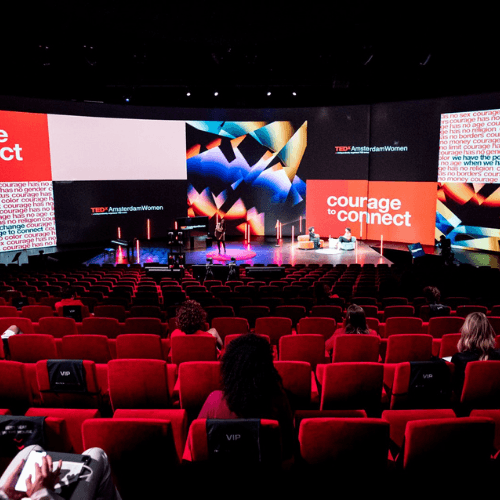
Have you ever had a zoom meeting with lagging connections? Terrible, isn't it? Nothing kills a productive meeting more than that. Imagine how killing it is for the atmosphere of a hybrid event. Everything stands or falls with good video, audio, and reliable internet connections, so do not skimp on this. The location of the offline event preferably has a large projection screen with projectors, experienced technicians, high bandwidth, cameras, and a good sound system. The XL studio of Theater Amsterdam is a beautiful example of a location for a hybrid event. You rent the hall and the technology including cameras, Vmix video registration, and a crew that operates it all for you and can advise you well.
5. Put the direction in the hands of a pro
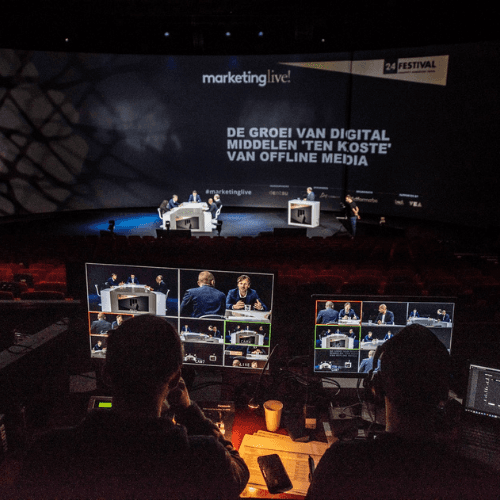
During a hybrid event, a lot happens simultaneously. Two programs, technology, timeslots, cameras... it feels like a live TV show. A director is what you need to make it all run smoothly. The director keeps an eye on the overall program and, as the communication pivot, ensures that the right people do the right things at the right moments. By involving the director in the organization of the event from the start, you benefit from valuable knowledge and experience, maximizing the chance of a flawless execution.
6. Good preparation is half the battle
With all that technology, different locations, and online elements, you need more preparation time. Calculate that in. Because setting up and testing all technical elements is something you don't want to skip. Lighting, camera positions, and internet connections are best optimized in advance and not while the event is already underway. Another element of preparation is instructing the participants. A clear log-in procedure ensures that online participants are ready on time and can feel the atmosphere right from the start. You can increase the engagement of online participants by sending a package of snacks and drinks in advance, along with potential giveaways. This way, you take care of the online participants during the event just as well as the offline participants.
7. Leave the participants with a good feeling
With this tip, we come full circle, because it can be linked to tip 1, the goal. Think in advance about what feeling you want to give the participants and make sure that is a common thread during the event. The fact that we have to hold hybrid events naturally has a negative connotation. It is a pity that it cannot just be 100% offline, and this is usually mentioned briefly. In addition, the distance in the room is also quite strange for the offline participants. Make sure that this feeling does not take over. A host can mention it once at the beginning, but prevent all speakers from going too deep into it. Focus on the desired atmosphere with a decorated event and enough distraction, making the participants forget the whole corona situation, if only for a little while.
Finally, it is recommended to stay in touch with the participants even after the physical event by sending an aftermovie, putting the entire stream online, and sharing the poll results so that the customer journey continues online afterward, keeping the audience engaged and already triggered to attend next time.
Theater Amsterdam has an XL studio with a spectacular semi-circular screen. An ideal location for hybrid events. We would love to show you how your hybrid event can be set up professionally. Please contact us or download our brochure about virtual and hybrid events first.

Eva Otto
Director
About Theater Amsterdam
Theater Amsterdam is a unique venue on the waterfront. With a Theater Hall for 1,100 guests and a Blackbox of 1,200 m², it offers everything for events up to 2,000 guests. The projection screen and technology ensure impact at congresses and shows.
Every event a show
Planning your event at Theater Amsterdam?
Based on your programme, we can immediately help you create a logical event flow.